Water Storage for Preppers
A complete guide to finding, purifying, storing and testing water, from rain barrels and DIY filters to emergency wells.
The Prepper’s Survival Bible · 31 pages · PDF
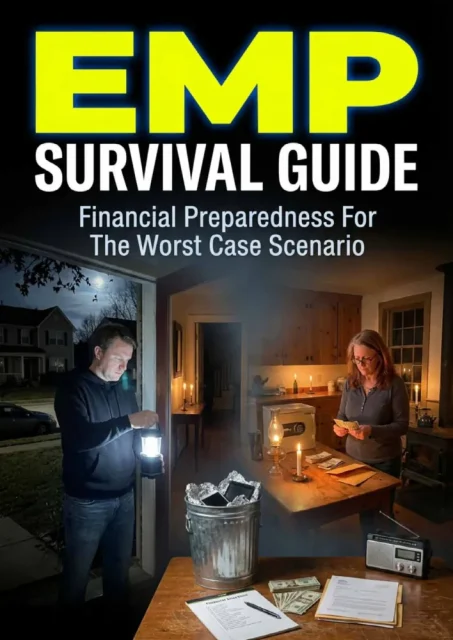
Financial preparedness for the worst case scenario
The financial side of a long grid-down event: budgeting, emergency funds, documents, bartering and recovery.
Most preparedness books focus on water, food and power. This one addresses a gap many plans overlook: money. If an electromagnetic pulse or a severe geomagnetic storm took down power and electronic systems across a region, card payments, online banking and ATMs could be unavailable. EMP Survival Guide helps you prepare your finances so a long grid-down event does not also become a financial crisis.
Chapter 1 explains what an EMP is, the history of EMP events and their effects, and the potential sources, including high-altitude nuclear detonations, geomagnetic storms triggered by solar activity and non-nuclear devices. The focus stays on why these events matter for financial stability.
Chapter 2 is a practical self-assessment: creating a detailed budget, evaluating your current financial assets and identifying potential sources of income if normal work is disrupted.
Chapter 3 covers preparation before an event: building an emergency savings fund, diversifying your investments and securing important financial documents so you can prove ownership and access accounts later. Chapter 4 looks at getting by during an event, including bartering and trading goods and services, protecting your financial assets and maintaining stability when electronic systems are down.
Chapter 5 turns to recovery: assessing the damage to your financial situation, creating a recovery plan and using available resources for financial assistance. Chapter 6 looks further ahead with investing in sustainable resources, establishing a more self-sufficient lifestyle and planning for future financial emergencies. The final chapter explains why building networks and working together makes communities more resilient, and ends with a financial preparedness checklist for EMP events.
Many of these steps, such as keeping some cash at home, organizing documents and maintaining an emergency fund, are sensible for any disaster, from hurricanes to regional blackouts. The book is educational and not personalized financial advice; consult a qualified professional before making investment decisions.
No. Its focus is financial preparedness: budgeting, emergency funds, protecting documents, diversifying assets, bartering and recovering financially after a major grid-down event. It explains what EMPs are, their history and where they come from as useful background, but it is not a technical guide to Faraday cages or shielding electronics.
Not at all. Keeping some cash available, securing key documents, maintaining an emergency fund and having a recovery plan are valuable for hurricanes, wildfires, regional blackouts, job loss and many other disruptions. The EMP scenario is simply a worst case that tests your plan thoroughly.
It discusses general principles such as diversification and investing in sustainable resources, for educational purposes. It is not personalized financial advice and cannot account for your income, debts or tax situation. Before changing your investments, speak with a licensed financial professional who understands your situation, goals and local regulations.
A complete guide to finding, purifying, storing and testing water, from rain barrels and DIY filters to emergency wells.
A practical pantry plan: essential emergency foods, staples that last for years and 18 preservation methods explained.
How to live without electricity: shelter, off-grid power, composting, heating and cooling, and staying healthy beyond the grid.
Turn supplies into a family plan: emergency kits, first aid, navigation without the internet and practical home security.
From flint and steel to a fire piston, learn reliable fire-starting methods for wet, windy, desert and forest conditions.
Turn fishing into a dependable food skill: gear, techniques, traps and nets, preservation and a year-round fishing plan.
Grow your own food, approach wild plants with caution and learn which herbs belong in a traditional home kit.
Twenty hands-on builds from everyday materials: water filters, stoves, lights, sanitation, signaling and small-scale power.